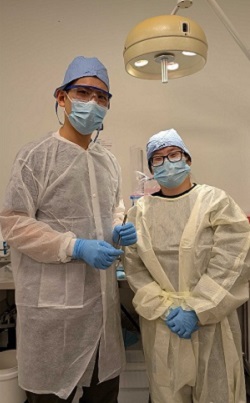
Dr Alvin Su, MD/PhD is an orthopedic surgeon at Nemours Children’s Health with dual fellowship training in sports medicine and pediatric orthopedics. Dr Su has a PhD in Materials Science and Engineering and serves as both an Associate Professor of Orthopedic Surgery at Thomas Jefferson University and an Adjunct Professor of Biomedical Engineering at the University of Delaware. Dr Su was awarded pilot funding from the ACCEL program in 2025.
Tell us a little about yourself, your research journey, and how you arrived where you are now.
“Throughout my orthopedic training and clinical practice, I have always been driven to answer questions and develop better solutions for my patients and fellow surgeons. To strengthen that ability, I pursued a PhD at UC San Diego, which I completed in 2014. My doctoral work focused on translational research in cartilage biomechanics and tissue engineering—areas highly relevant to my sports medicine practice, where I frequently treat cartilage lesions and meniscal injuries.
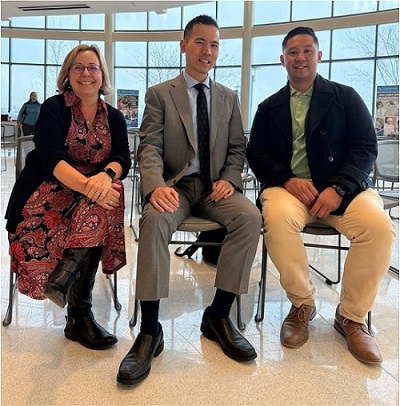
After joining Nemours Children’s Health, I continued to pursue research opportunities and eventually met two outstanding collaborators: Dr. Dawn Elliott, who has also served as a wonderful mentor, and Dr. Justin Parreno. Dr. Parreno started at the University of Delaware not long after I arrived at Nemours, and we have grown our research efforts together. Through many brainstorming sessions, grant applications, and collaborations, and with strong support from my orthopedic department at Nemours, we have been able to build a growing and productive research program.”
Tell us about your research. What is the area of focus, what are your research goals, and what is the significance of the research?
“Our CTR project focuses on the biomechanics of the meniscus after surgical repair. While meniscus repair procedures are clinically successful, there is still limited understanding of the mechanical environment of the healing meniscus. This lack of biomechanical evidence makes it difficult to design optimal post-operative rehabilitation protocols.
If rehabilitation is too aggressive, there is concern about disrupting meniscal healing. If it is too conservative, patients may experience muscle atrophy, joint stiffness, and delayed recovery. Our goal is to better understand the mechanical behavior of repaired meniscal tissue so that we can provide evidence-based guidance for rehabilitation. Ultimately, this work aims to improve recovery and long-term outcomes for patients undergoing meniscus repair.”
How has the ACCEL program helped with your project (grant writing, mentorship, help accessing funding, etc)?
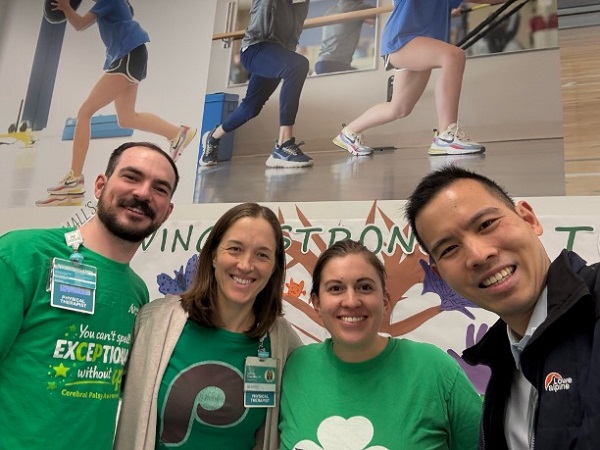
“The ACCEL program has been incredibly valuable as a collaborative hub that brings together talented investigators across disciplines. Physical therapists are integral to both our sports medicine practice and research efforts. Our Co-Investigator, Michelle Feairheller, MDP, tDPT, along with our clinical partners—Rebecca McCammitt, PT, DPT, and Meghan Courtois, PT, DPT—provide critical insights into the rehabilitation of patients following meniscal injury and surgery. In addition, working with Dr. Elliott and co-mentoring our postdoctoral fellow, Dr. Maelyn Arcordia, within the ACCEL framework, has helped create a close-knit research network. The CTR pilot grant has been particularly important for us. It provides foundational support that allows us to generate preliminary data and build the groundwork for future external funding applications.”
Have you faced any major obstacles with your research project?
“One initial challenge was navigating the cross-campus nature of our project between Nemours and the University of Delaware. Establishing the logistics and administrative processes required some early coordination, but once those systems were in place, the collaboration has worked very well.
Another challenge occurred in 2025 with the sudden pause in NIH funding, which also temporarily affected CTR pilot grants. Like most research projects, there are always unexpected challenges when experiments are actually underway. Troubleshooting and creative problem-solving are part of the process—both the difficult and rewarding aspects of doing research.”
What do you hope to be the impact of this research, and what future directions do you see related research going?
“Our immediate goal is to build a strong foundation through the CTR pilot project and then pursue larger federal-level grants. The question we are studying is highly relevant to everyday clinical practice. Orthopedic surgeons and physical therapists frequently face uncertainty when determining rehabilitation protocols after meniscus repair. By better understanding the biomechanics of the repaired meniscus, we hope to provide evidence that can directly guide rehabilitation strategies and ultimately improve patient recovery after surgery.”
Is there anything else you would like to add regarding yourself, your research, or the ACCEL program?
“Surgeon-scientists have sometimes been described as a “vanishing species,” and I am proud to be part of that tradition. Being trained both at the bench and at the bedside allows me to understand problems from both perspectives and to help translate clinical challenges into meaningful research questions. Programs like ACCEL are extremely important because they encourage and support clinician investigators. That support has been a major positive force in building our local research community.
Being a surgeon-scientist is inherently challenging. We have the same 24 hours in a day as everyone else, yet we balance patient care, surgery, academic responsibilities, trauma call, family life, and scientific research. Additional structural support—such as in-kind matching funds to help support research staff, postdoctoral fellows, or protected time for investigators—could significantly strengthen research teams and allow them to focus more fully on the science.”
Alvin Su, Michelle Feairheller, and others
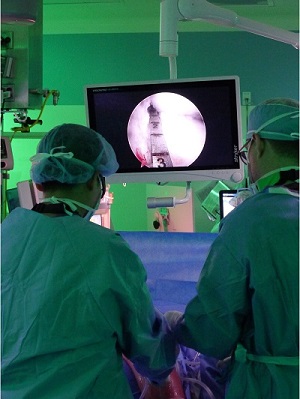
Dawn Elliott, Alvin Su, Justin ParrenoSuregry in action- clinical translation is our goalTeamwork is key!Alvin Su and Maelyn Arcodia